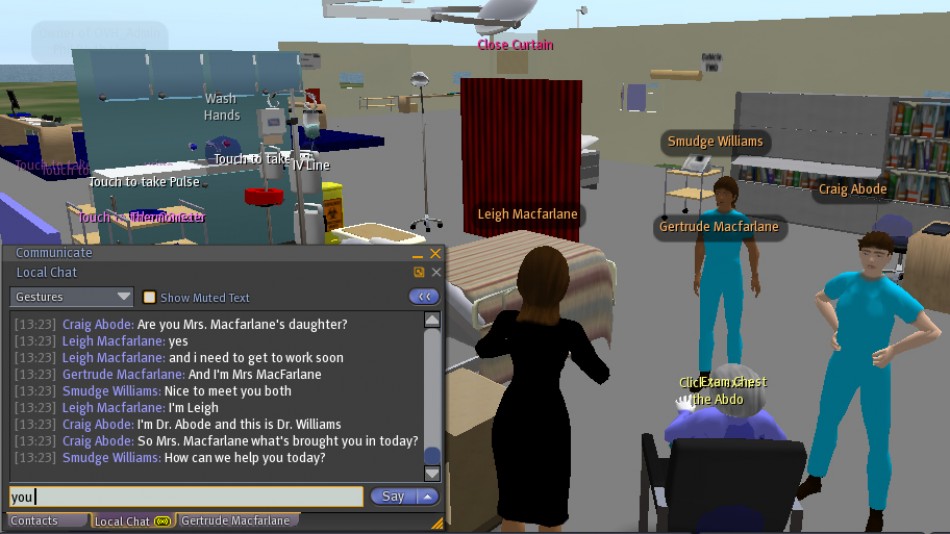
Many educational technologists claim that students can learn physical-world skills in virtual worlds – a desktop simulation of a hospital’s emergency department for example. But is this really the case?
This question is at the heart of research by Kin Loke, an Online Learning Designer at Otago Polytechnic.
“To examine the abdomen of a patient, you click a button that says ‘examine abdomen’ and then you get a text response advising you that there’s a hard mass felt. But that’s unrealistic – it’s nothing to do with actually feeling a person, so what are the students learning?” he asks. “They’re definitely not learning about how to physically examine someone’s abdomen or getting a sense of actual tactile resistance.”
Research shows that people do learn from virtual worlds – how to apply certain thinking processes, for example. But Kin challenges claims that students are getting ‘hands-on experience’ in virtual worlds.
“The basis of virtual world learning isn’t concrete or physiological, and I think we should stop talking about virtual world learning in those terms,” he says.
He turns to the work of British philosopher, John Austin, to explain what he thinks is happening. “Austin said there are a few conditions – social conventions – under which words constitute actions, such as declaring an event open or declaring a couple man and wife,” Kin says. “The same can be said of clicks on a computer. Under the same conditions, clicks can become actions that have an effect.”
He recalls an instance in a virtual hospital setting, where a ‘patient’ got upset when the ‘doctor’ forgot to close the virtual curtain before examining her.
“Now why did she get upset? She wasn’t actually humiliated, there was no physical examination,” he notes. “Austin would say there is a certain reality around that action which results in real consequences – a semantic reality.”
To further illustrate this idea, Kin uses the example of the ‘raise hand’ button in conferencing software. “If you do this repeatedly – click, click, click, click – it will annoy people. Clicking on the button repeatedly when you don’t mean to raise your hand will produce certain effects on others.”
Student experiences back up this idea, with higher emotional investment in simulations compared with paper case studies. “Paper case studies don’t respond to you and your actions,” Kin explains. “Virtual worlds are really just pictures, but because they respond to actions the students talk about their patients as if they were real people. They’re genuinely disappointed or saddened when there is a negative outcome for a patient.”
The lesson Kin wants educational technologists to take home is that they are often “overselling” the technology. “The literature is full of descriptions of these desktop virtual worlds being immersive worlds – yet students are physically detached, controlling the virtual world remotely with a mouse and a keyboard. But the semantic reality aspect should be acknowledged – for example, I do think there’s cause for concern if a junior doctor repeatedly kills their virtual patient,” he laughs.
Kin’s next research project will embrace the same philosophy and apply it to the world of violent video games. “Many gamers say violent video games are just pixels, but I think that’s naïve. There is a social reality around the actions they take in these games, just as there is in virtual education realms,” he says.
Loke, S.K., & Golding, C. (2016) How to do things with mouse clicks: Applying Austin’s speech act theory to explain learning in virtual worlds. Educational Philosophy and Theory. doi:10.1080/00131857.2016.1138394